Above are the slides from my talk from the American Real Estate Society Conference just recently held in St. Petersburg, Florida.
--Corey
Above are the slides from my talk from the American Real Estate Society Conference just recently held in St. Petersburg, Florida.
--Corey
Last Saturday marked the first birthday for the World Wide MLS (WWMLS). Since then, the follow progress has been made towards WWMLS:
As MLSN is presented to different groups such as academics and technologists, I am confident with the two upcoming presentations in 2012, especially in St. Petersburg at ARES, that the MLSN Protocol and WWMLS framework will alter others' thought processes of not only the dysfunctional aspect of today's legacy MLS, but also future directions in how real estate consumers interact and expect a specific quality of service (QoS) from real estate professionals. The main intention is integrate WWMLS in every aspect of the future of real estate.
Moving foward, the second phase for WWMLS will be the introduction of the messaging language called Real Estate Metadata Language (Remetal). This XML language will be used to markup properties in a self-describing, yet simple language for sending and receiving between the main OpenMLS Registry and accredited OpenMLS Registrars. I plan to propose Remetal to additional call for papers (CFP) on the academic and technical levels in 2012.
The third yet most important phase will be for the Real Estate Transport Protocol (RETP). This protocol defines the type of messaging, the distribution channels, error correction system, etc. Again, RETP papers will be proposed along with exhibitions at national and if necessary global science fairs.
The future of real estate is bright and changing.
And as the cliche goes, please stay tuned...
--Corey
Today I submitted my abstract for the American Real Estate Society (ARES) conference in April next year:
Title: MLSN: A Request and Response Internet Protocol for Real Estate Property Listings
Abstract:
Sellers list their properties with real estate professionals who enter property information into private databases called Multiple Listing Services (MLS). These MLS's attempt to store and index data listings with serialized numbers that only members of the local real estate association have access to query, insert, and update. In the United States alone, there are over 900 MLS's which unfortunately create redundant, localized MLS numbers causing confusion over specific properties and their respective listing information on the Internet. These duplicated MLS numbers can be anywhere from five to ten digits long or more relaying no meaningful or geographical information to real estate professionals, sellers, and buyers alike.
This paper proposes and discusses a new internet protocol called Multiple Listing Service Network (MLSN) Protocol for registering, assigning, and distributing property listings on the Internet. Similar to the WHOIS protocol, MLSN is an application publicly available on the Internet, however instead of port 43, MLSN is accessible from reserved port 32801. The numbering scheme is comprised of two parts separated by an '@' symbol: (1) a triple-dotted notation of three decimal integers ranging from 1 to 65,535 and (2) a double-dotted notation number composed of a postal code and country code standardized by ISO 3166-1. Taking in consideration for expired listings, MLSN offers a reusable feature which allows assigning a new, double-dotted notation number to a preexisting triple-dotted number thereby creating a new MLSN property listing number. Together with a standard protocol and unique numbering schema, MLSN provides a uniform resource locator (URL) to users for conducting a more efficient and convenient real estate property searching on the Internet.
Keywords: internet, multiple listing service, protocol, internationalization
--Corey
A couple of weeks ago, I submitted my continuing research for the Multiple Listing Service Network (MLSN) Protocol to the University of Central Florida's Graduate Research Forum.
Below is an image of a conceptual drawing of my poster board presentation I sketched on the back of a napkin.
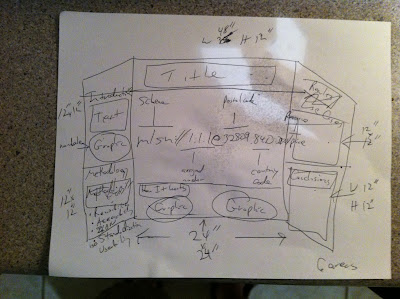 |
| From UCF Graduate Research Forum 2011 |
And below is the finished product:
 |
| From UCF Graduate Research Forum 2011 |
As a side note, I added QR Codes for others to scan with their mobile phones and visit the presentation and specification online.
Related Links
--Corey
Next week, I will submit the following research abstract to the Graduate Research Forum at UCF. I am currently working on my Master's in Nonprofit Management in the College Public Administration. In addition to the abstract below, I will also follow up with a white paper explaining the Multiple Listing Service Network (MLSN) Protocol and system in detail.
Abstract
Sellers list their properties with real estate professionals who enter property information into private databases called Multiple Listing Services (MLS). These MLSs attempt to index listings with serialized numbers that only members of the local real estate association have access to query, insert, and update. In the United States alone, there are over 900 MLSs which unfortunately create redundant, localized MLS numbers causing confusion over specific properties and their respective listing information on the Internet. These duplicated MLS numbers can be anywhere from eight digits or more relaying no meaningful or geographical information to real estate professionals and real estate buyers alike.
In this paper I introduce a public, standardized numbering system and protocol called Multiple Listing Service Network (MLSN). Similar to the Web, MLSN is an application publicly available on the Internet, but instead of port 80, MLSN is accessible from port 32801. The numbering scheme is comprised of two parts separated by an '@' symbol: (1) a triple-dotted notation of three decimal integers ranging from 1 to 65,535 and (2) a double-dotted notation number composed of a postal code and country code defined by ISO 3166-1. Taking in consideration for expired listings, MLSN numbers have a reusable feature which allows assigning a new, double-dotted notation number to a preexisting triple-dotted number thereby creating a new MLSN number. Together with a standard protocol and unique numbering schema, a Uniform Resource Locator (URL) is available to users for searching for property listings on the Internet.
--Corey
Scenario: User wants to know the status of a property listing in the downtown Orlando zip code, 32801, located in the United States.
A user starts a session on a client desktop. He enters the following MLS Number URL at the prompt:
user>mlsn 1.1.1@32801.840/status
The mlsn client application sends the MLSN URL via port 32801 over tcp through the internet to an MLSN Messaging Server which accepts the text string via port 32801.
The MLSN Server routes the URL text string to an application server which parses and creates a query for the database which returns a result.
Finally, the client desktop receives the result via port 32801 and displays the results to the user:
user>active
--Corey
One of the problems in the Real Estate Industry revolves around the numbers assigned to listings by Multiple Listing Services. Six, seven, eight, or more numerical digits may be assigned to an individual MLS listing number along with possible alphanumeric characters preceding the number.
From my research, listed below are ten randomly selected, real world MLS numbers I extracted from a daily Google Alert listening for text string 'MLS#':
The problem with these numbers and others is that they have no visual value or meaning to a user. MLS numbers are stored and generated within datatbases by MLS providers. Since these numbers are required to be unique, a field type of serial is assigned to the field which increments the next unique MLS number by 1 to enforce a primary key's uniqueness. However, this system does not benefit the user from deciphering where the listing is located nor any other details.
Another problem is that there are hundreds of MLS's in existence and the probability of the same number assigned to two different listings in two different MLS databases is highly probably. If a user only has the number to reference, which listing number is which? And how much time is lost trying to figure out which listing corresponds to which MLS database?
Since MLS numbers are simply incremented by 1, the opportunity for number reuse is eliminated. A provider's MLS numbers will continue to increase by 1 which will increase the number of digits of the MLS numbers over time. Having no delimiters, MLS numbers become humanly impossible to remember since the average human is said to only have the capacity to remember up to 7 consecutive digits. But looking at the random MLS numbers I collected above , a high percentage of real world MLS Numbers either equal or are greater than 7 digits.
The MLSN URL scheme is used to designate Internet MLS listings accessible using MLSN (Multiple Listing Service Network). The scheme adheres to IETF's RFC1738 which describes syntax for strings representations or URLs via the Internet.
After a user posts a listing to a registrar, a 3-octet number is assigned to a listing just like an IP address is statically assigned to a machine or device. But in the case of the MLSN protocol, 3-octet numbers are dynamically assigned to allow for reusability. After a listing expires, the 3-octet number returns to the registrar's pool to be later reassigned to alternate user's listing.
For example:
User registers listing with AlicesMLS and receives the following MLS Number URL Address:
mlsn://1.1.21@32821.840
The listing expires after 30 days and 1.1.21 returns to the registrar's pool of mls numbers and is reassigned to another user's listing:
mlsn://1.1.21@32819.840
The new MLS URL Address reuses 1.1.21, but is a different listing from the previous listing.
Note: 1.x.x is designated as a reserved Class A block of numbers and used for testing purposes.
By adding a local postal code to the URL, the listing becomes visually meaningful. Just by looking at the URL, a user can tell if the MLS listing is located in an ideal or non-ideal postal code area. In addition, postal codes are used by the majority of the world's countries which makes MLSN URL's extensible to potentially cover any property in the world.
Keeping the global MLS market in mind, a 3-digit country code follows the postal code. Every country is designated with an ISO 3166-1 3-digit number.
This number enhances an MLS Number URL for reusability and visual meaning when coupled with the postal code.Two weeks ago, I secured internet port 32801 with IANA on its list of registered ports.
mlsn            32801/tcp   Multiple Listing Service Network
mlsn            32801/udp   Multiple Listing Service Network
#                           Corey Leong  27 January 2010
The purpose of this new port will be to send and receive request and response messages from client machines to designated mlsn servers. This type of messaging mirrors the whois service which enables a user to lookup domain names over port 53.
Using a RESTful approach, a resource appended to the URL string permits lookup of a particular attribute of the listing.
For example:
A client sends the following request to an mlsn server.
mlsn://1.1.17@32802.840/status
The mlsn server returns "active" to the client, then the connection is severed.
Other potential resource lookup scenarios include beds, baths, square footage, price, etc.
The above information is a high-level perspective of the Multiple Listing Service Network (MLSN) Protocol, URL, and Port. MLSN is in development mode. Eventually, MLSN will be used by any user to query MLS Listings from registrars over the Internet.
I intend to continue testing a multitude MLS Number URL strings until this protocol reaches full 1.0 version.
--Corey


